
Workshop Notes
Diamond and Gemstone Setting: Prong, Bezel, Pavé and Channel Explained
A practical guide to prong, bezel, pavé and channel settings, how stones are set under the microscope, and how setting affects durability.
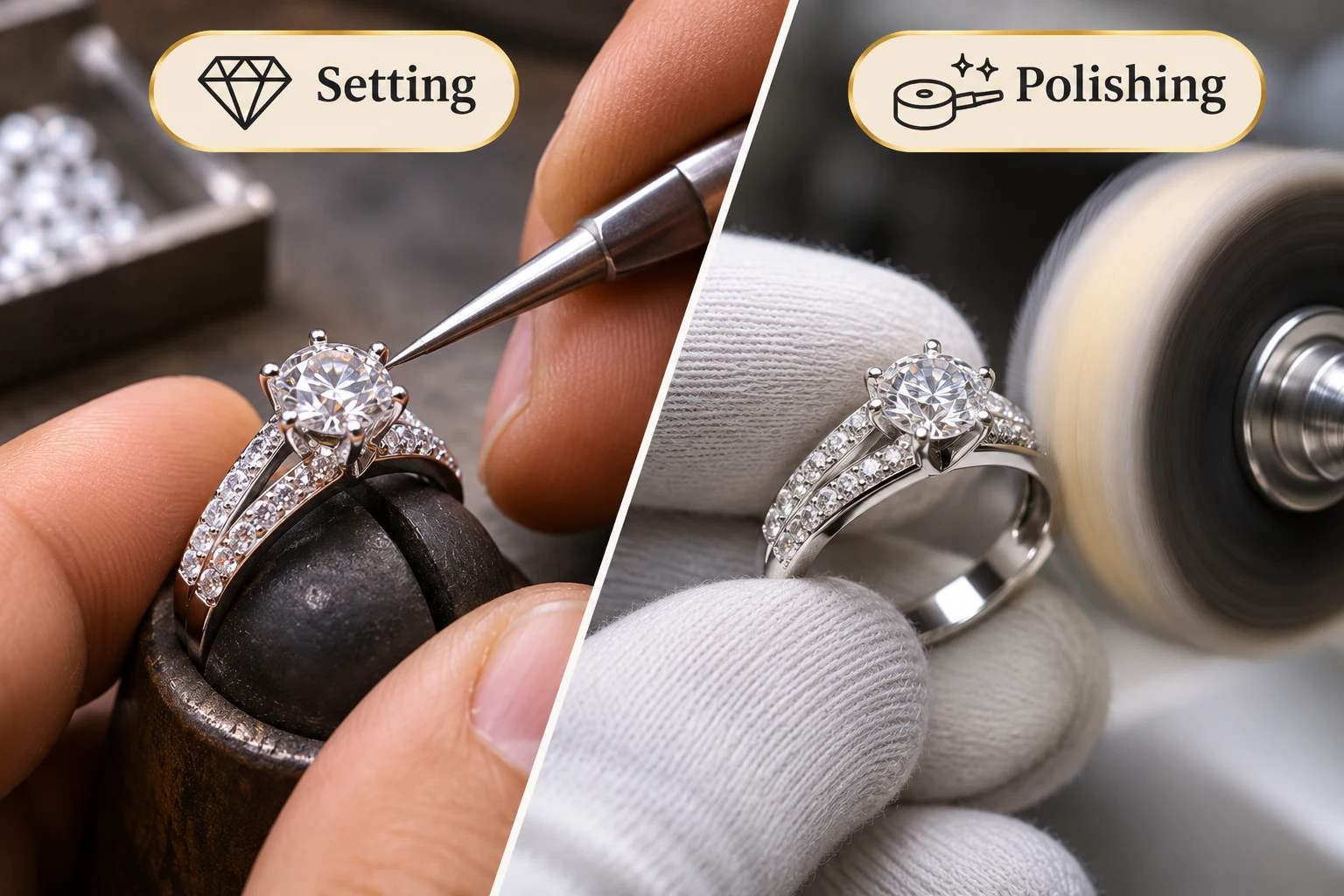
Where most of the skill and time goes
Stone setting is the stage that turns metal into fine jewellery, and it is also the stage that decides whether stones stay put for years or fall out in months. Our setters work under stereo microscopes, because a good setting is measured in fractions of a millimetre: the seat has to be cut to the exact angle of the stone, and the metal has to be moved over it evenly without chipping it.
For designs with many small stones, setting takes far longer than any other step. That is why stone count has such a big effect on lead time and price.
Prong setting
Prongs, also called claws, are small metal tips that grip the stone. Four or six prongs are the classic choice for solitaires because they let in the most light and show off the stone. Six prongs give a little more security and a rounder look; four prongs show more of the diamond. Prongs need to be thick enough to wear well, and our CAD stage is where we make sure they are.
Bezel setting
A bezel is a thin wall of metal that wraps around the edge of the stone. It is the most protective setting, which makes it popular for everyday rings, active wearers and softer gemstones. A full bezel gives a modern, clean look; a half bezel leaves the sides open for more light.
Pavé and micro pavé
Pavé means paved, and that is the look: a surface covered with small diamonds held by tiny beads of metal raised from the surrounding area. Micro pavé uses even smaller stones and beads for an almost continuous sparkle. It is beautiful, but it needs very precise seats and a steady hand, and it is where microscope setting really matters.
Channel and other settings
In a channel setting, stones sit side by side between two walls of metal with no prongs between them. It suits baguettes, princess cuts and eternity bands, and it protects stone edges well. Other styles include tension, flush and invisible settings, each with its own look and limits. We will recommend the setting that suits your design, stone type and the way the piece will be worn.
Natural, lab-grown and gemstones
We set natural diamonds, lab-grown diamonds, moissanite and coloured gemstones. Each has different hardness and behaves differently under pressure, so setters adjust their approach. For larger diamonds, SGL, IGI or HRD certificates are available on request, and the stone type is always stated clearly in your quote and invoice.
Related KNC services
Frequently asked questions
What is the most secure diamond setting?
A bezel setting is generally the most secure because a metal rim surrounds the stone. Well-made six-prong and channel settings are also very secure.
What is the difference between pavé and micro pavé?
Both cover a surface with small diamonds held by tiny metal beads. Micro pavé uses smaller stones and beads, which gives a finer, more continuous sparkle but needs more precise setting.
Why does stone setting affect lead time?
Each stone is set individually by hand under magnification. A design with dozens or hundreds of small stones takes much longer to set than a solitaire.
Workshop Checklist
Put it into practice
Choose a setting that suits how the piece will be worn, keep prongs and bezels strong enough for daily use, and expect stone count to drive lead time.