
Workshop Notes
Wax Prototyping and Mould Making in Jewellery Manufacturing
Why every design is printed in wax or resin before casting, what a prototype check catches, and how rubber moulds make repeat production consistent and affordable.
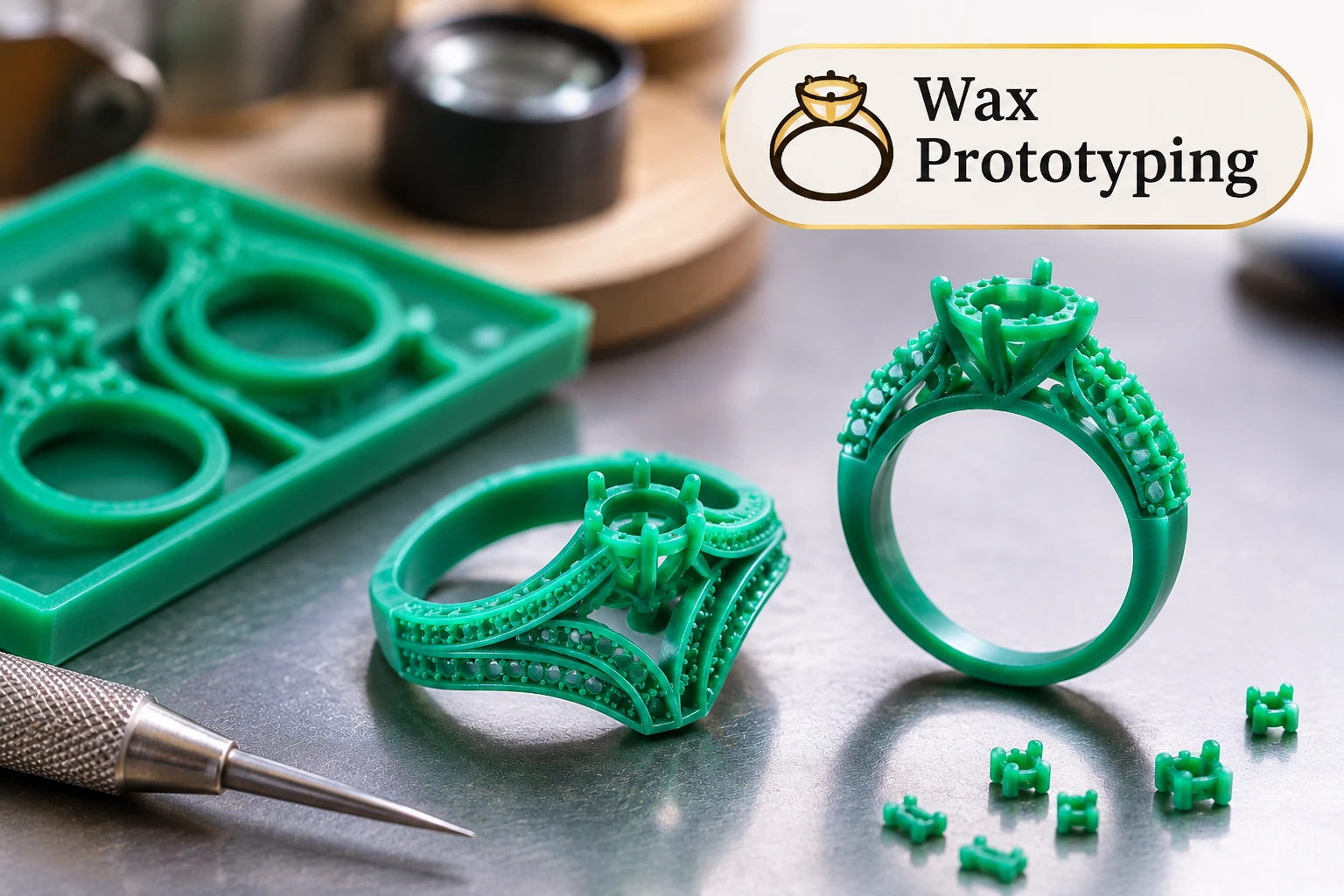
From screen to something you can hold
A CAD render can be perfect and still be misleading. Screens make everything look the same size, and it is surprisingly hard to judge how a 3 mm band or a 6 mm setting will feel in real life. That is the job of the prototype: to turn the approved CAD file into a physical model before any precious metal is used.
In our workshop, prototypes are printed on high-resolution 3D printers in castable wax or resin. The detail is fine enough to show individual prongs, pavé beads and engraved patterns.
What a prototype check catches
The prototype is checked on a ring mandrel for size and against the CAD measurements for proportion. We look at how the setting sits, whether the gallery under the stone is open enough to clean, and whether thin areas might be fragile once cast.
For buyers, the prototype answers practical questions a render cannot. Does the pendant hang straight or tip forward? Do the earrings look balanced as a pair? Is the ring comfortable to wear next to a wedding band? If something needs to change, the fix goes back into the CAD file, and a new prototype is printed. No metal is wasted.
Wax versus resin prototypes
Both are used, and the choice depends on the job. Castable wax gives very smooth surfaces and burns out cleanly during casting. Castable resin is a little tougher, which helps with delicate designs that need to survive handling and fitting checks. Either way, the prototype printed for approval can usually be the same model that goes on to be cast for your physical sample.
Mould making for repeat production
Printing a new model for every single piece makes sense for one-off custom work, but not for a collection of 100 rings. For production runs, a master model is cast in metal, finished carefully, and then used to make a vulcanised rubber mould.
Hot wax is injected into this mould to produce identical wax copies quickly and consistently. Those waxes are assembled on a casting tree and cast together. A good rubber mould keeps every piece in a batch the same size and shape, lowers the cost per piece, and makes reorders straightforward because the mould is kept for your next order.
When to use which method
For custom pieces, samples and small quantities, 3D printed prototypes are faster and more flexible. For repeat styles and larger runs, a master model and rubber mould give better consistency and lower unit cost. Our team will suggest the right route when we quote, based on your quantities and how often you plan to reorder.
Related KNC services
Frequently asked questions
What is a wax prototype in jewellery?
It is a physical model of the design, 3D printed in castable wax or resin from the approved CAD file. It is used to check size, proportions and comfort before the piece is cast in metal.
What is a rubber mould used for in jewellery making?
A rubber mould is made from a finished metal master model. Wax is injected into it to create identical copies, which makes production runs faster, more consistent and more affordable.
Can the prototype be changed after I see it?
Yes. Changes are made in the CAD file and a new prototype is printed. This is much cheaper than making changes after casting.
Workshop Checklist
Put it into practice
Check the prototype for size, balance and comfort before casting, and ask about a production mould if you plan to reorder the same style.