Workshop Notes
Precision Investment Casting and Induction Casting for Fine Jewellery
How lost wax investment casting works, why vacuum induction casting gives cleaner gold, silver and platinum castings, and what causes porosity.
The oldest step, made precise
Lost wax casting has been used for thousands of years, and the basic idea has not changed: make a model in wax, surround it with a heat-proof material, melt the wax away, and pour metal into the space it leaves behind. What has changed is the precision. Modern investment powders, controlled burnout and induction casting machines now let workshops reproduce details finer than a human hair.
Building the casting tree
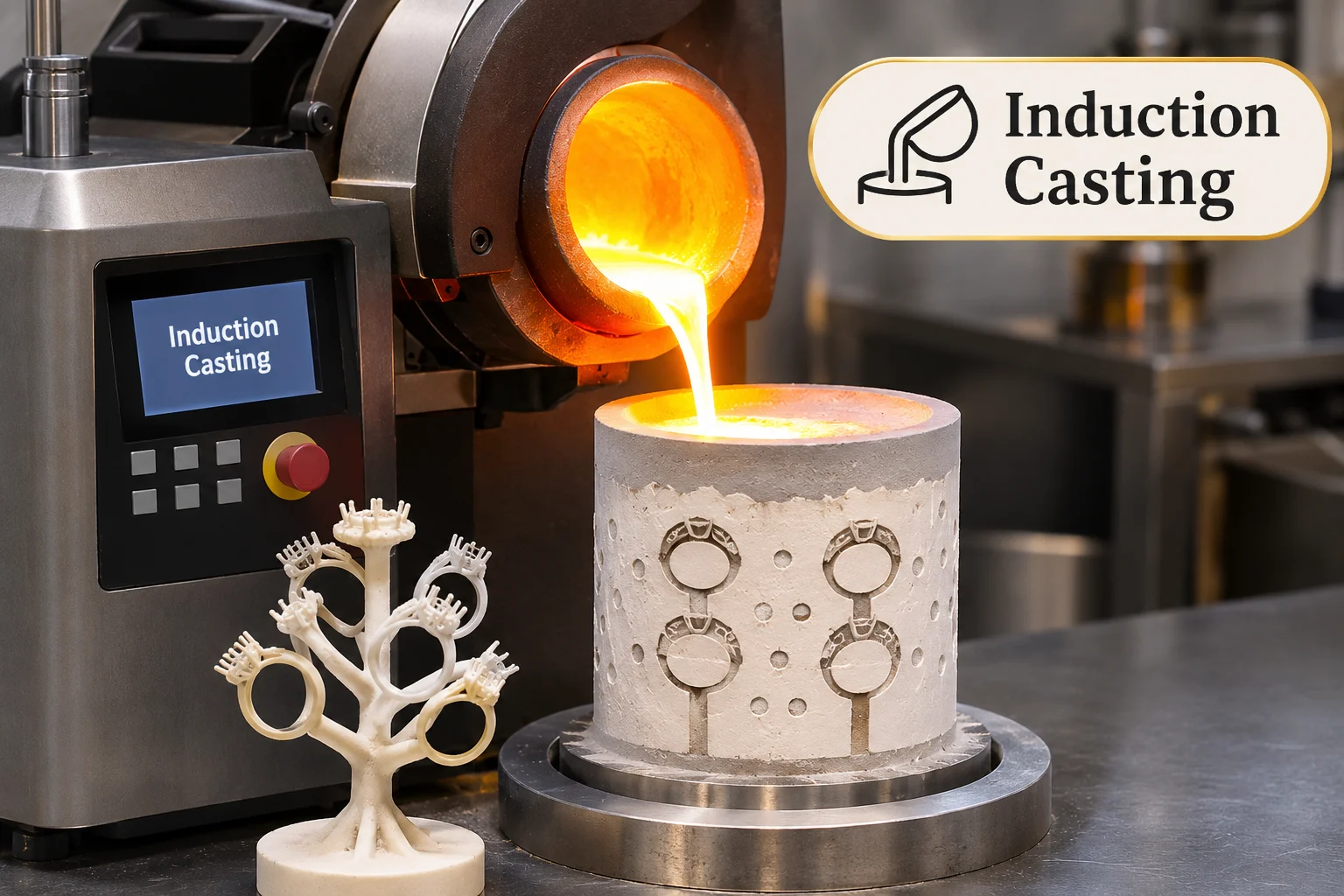
Approved wax or resin models are attached by thin wax stems, called sprues, to a central wax trunk. The result looks like a small tree, and it allows many pieces to be cast in one pour. How the pieces are placed on the tree matters: metal needs a clear path to flow into every part of every piece, and heavy and delicate designs are positioned so they fill properly.
Investment and burnout
The tree is placed inside a steel flask and covered with investment, a fine plaster-like material that captures every surface detail. Once it sets, the flask goes into a kiln and is heated slowly through a controlled cycle. The wax melts and burns out completely, leaving a hollow, highly detailed mould inside the investment.
Rushing this stage causes trouble later. Any wax residue left behind can show up as rough surfaces or holes in the metal.
Why we use vacuum induction casting
Induction casting melts the metal with an electromagnetic field rather than an open flame. The temperature is easier to control, the melt is cleaner, and less metal is lost to oxidation. Under vacuum, the molten metal is drawn deep into the mould so fine prongs, pavé seats and thin sections fill completely.
This matters most for platinum, which melts at well over 1,700 degrees Celsius and is unforgiving of poor technique, but it improves 14K and 18K gold and 925 sterling silver castings too. We confirm the metal and fineness in your brief and cast with fresh, measured alloy for each order.
Avoiding casting defects
The most common casting defect is porosity: tiny holes caused by trapped gas or metal shrinking as it cools. Others include incomplete fills, rough surfaces and cracks. Most are prevented by good sprue design, correct burnout and controlled metal temperature.
Every casting is cleaned and inspected before it moves on to filing. A faulty casting is far better caught here than after hours of setting and polishing.
Related KNC services
Frequently asked questions
What is investment casting in jewellery?
Investment casting, also called lost wax casting, is a method where a wax model is covered in investment, the wax is burned out, and molten metal is poured into the hollow mould to create an exact metal copy.
What is the advantage of induction casting?
Induction casting melts metal with controlled electromagnetic heat, giving a cleaner melt, more accurate temperature and less metal loss. Combined with vacuum, it fills fine details more completely.
What causes porosity in cast jewellery?
Porosity is usually caused by trapped gas or metal shrinking as it cools. Good sprue placement, proper burnout and controlled casting temperature greatly reduce it.
Workshop Checklist
Put it into practice
Choose your metal and fineness early, ask how fine details will be cast, and expect every casting to be inspected before finishing begins.